The Vizsla Newzsletter (Dec97/Jan98) |
|
In our last chapter, while pheasant hunting at Illinois' Chain O' Lakes Park, the
Grizzled One had come across a hunter who was upset at his German Shorthair
puppy for not hunting. It was a cold and rainy November day. The pup was wet,
cold, and very tired. It was easy to see that the hunter knew little about hunting dog
behaviour, or the lack of it. He was following the path that so many hunters who buy
a hunting dog follow, "I bought a hunting dog. So, dog go hunt." Never realizing all
that must be done before the dog is taken out for its first hunting trip. Ed, the young
dog owner, accompanies the Grizzled One back to his motorhome for hot coffee and
without his realizing it, some information about hunting dogs.
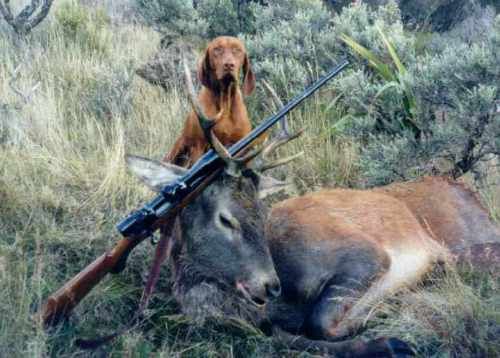
Photo: Another great photo of
The Grizzled One took a luxuriant pull from his coffee mug and said "When you think about it, when a guy gets a hunting dog, the actual hunting is for only a part of the year. The rest of the time the dog is, I hope, a family dog. Pet, companion, guard, all those things you think of in association with the word dog. Every once in a while I get asked about recommending a breed of hunting dog and my reply is always the same. Take out a sheet of paper and make four columns on it. In the first column, list the game that you most often hunt for. In the second column state the kind of terrain, cover and the important environmental considerations. Heat, cold, water, or snow that the dog will encounter while hunting for the game you listed in the first column. The third column should indicate important residential factors such as apartment or house, single, married, children, city, country, etc. Finally, in the last column, list the names of the breeds that possess those characteristics that would enable them to be a happy, productive dog in the situations you have described in the first three columns." "Your local library should be able to provide you with the references that you need for breed characteristics. Seems like a lot of work, but remember, barring accident or sudden acute illness, the dog you decide on is going to be with you for many years. You want to make the most intelligent choice you can." Ed looked across the table at the Grizzled One and said "But you aren't saying what breed you recommend." The Grizzled One chuckled and said "Ed, there is no best breed except in the eyes of the dog owner who swears that his dog's breed is the best. The simple fact is, they are all the "best" breed and that's the way it should be." The Grizzled One looked out the window and exclaimed, "Hey look! The rain seems to have stopped. Tell you what Ed, why don't you let your pup rest a bit more. We can take one of my dogs out and see what it can find" The Grizzled One had expected some resistance from the other hunter. Ed appeared to be the type of guy that sticks to the program he has decided on. Even if the program was not too good. The Grizzled One was pleasantly surprised when Ed said "Sounds good to me. Should we take Benji along? He might learn something from your dog." "I know that is a popular idea among a lot of hunters. To take a young dog out hunting with an older dog who will "teach" the youngster the "tricks of the trade" as it were. I have a kind of a different spin on that. Just imagine this scenario. The boss comes up to a long time employee and introduces the older worker to a much younger employee who was just hired. The boss informs the older guy that he is to teach the young worker all he knows, because he is going to replace the older worker. How do you think the older man (or gal) will feel about that situation? Well, an older dog kind of feels the same way. I never take a young beginning bird dog hunting with an older dog. I will train a young dog with an older dog on very specific tasks that require two dogs, but never in a hunting situation. Hunting is R&R for my dogs. They shouldn't have to concern themselves about the presence of a young whippersnapper." As Ed was digesting this he said "Well then I better put Benji in my car." The Grizzled One replied "I have an extra smaller crate that Benji is welcome to use .If you have something in the car that he likes to lie on, put it in the crate and he will be fine. If he starts to bark, Penny will let him know that is a no-no. She has no tolerance for barking that has no reason. She has a snarl that the little guy will be quite impressed with." "Which of your dogs are you going to take out" asked Ed. With no hesitation the Grizzled One said "Rowdy Roy. You will find him a very interesting dog to hunt over." "Why is that?" Ed questioned. The Grizzled One replied "Rather than tell you all about Rowdy, I want you to hunt over him first. Then I will tell you about him." With Benji crated, Rowdy was let out of his crate and the muscular male immediately went to Ed and introduced himself. The Grizzled One busied himself preparing the dog for the hunt. He put a collar with a black cylinder attached to it on the dog. "Is that one of those collars that you can shock a dog with to make him obey?" Ed asked. "No, this is what's commonly called a "beeper" collar. It sends out a sound signal that enables you to not only know where your dog is in heavy cover, it also lets you know what the dog is doing. Even more importantly, it alerts other hunters in the area that the dog is there." Next to go on the dog was a wide blaze orange collar. "This makes it easier to spot the dog if it is ranging out or is in heavy cover. My dogs start wearing such a 'flash" collar the first time they go into the field. They associate the collar with bird work. When they come in from the field, the collar comes off. They never wear it just to wear it. In its way, I guess you can say that it is kind of a training aid." With that the trio emerged from the motorhome, guns in hand and Rowdy impatiently walking in front of them on lead. "I never turn my dog loose until I reach the exact spot I want to hunt." explained the Grizzled One. "Fellows are returning to their cars in the parking lot. Many of them allow their dogs to run right up into the parking lot. I just don't want one of my dogs barging into a situation like that." When they reached a grassy field that bordered a wooded area, the Grizzled One put Rowdy on a "stay" command and took the lead off of him. He then turned to Ed and told him to load up. When hunting with the Grizzled One, guns are never loaded until you get to where the hunt is going to begin and the dog is on "stay". He then walked over to Rowdy and gently tapped him on the top of his head. Rowdy did a silly dance around the hunters and made a straight cast towards a small stand of shrub thicket. "We'll just kind of walk easy and more or less follow Rowdy. He knows more about where pheasants are likely to be than we do. So he is the boss in terms of the route we will follow." directed the Grizzled One. "He sure seems to know what he is doing." said Ed as his eyes watched the lithe Vizsla circle the thicket. Rowdy moved off toward the edge of the woods which bordered the grass field that they were in. "Why didn't he go into the thicket. I would think that is what a good hunting dog would have done?" Ed queried. The Grizzled One reached down to the ground and pulled up a handful of dead grass and tossed it into the air. "What happened when I threw the grass clump into the air Ed?" he asked. "The wind blew it" was the reply. "That's right and the same thing happens to scent when the wind hit it. Rowdy is a veteran hunter. He knows that when he is downwind, the scent of any game will be blown at him. Therefore, it was needless for him to penetrate that thicket. If there was game in it, he would have locked up on point right at the edge of the thicket. The fact that he circled downwind of the thicket and then moved away from it told me that there was no game in the thicket and to keep on walking. You see Ed, if you have a well trained and confident dog, you let the dog do the walking. Why go tramping through thickets and other kinds of dense cover when the dog can do it in a far more efficient manner?" "Have you heard the beeper sounds from Rowdy's collar?" asked the Grizzled One "Yeah, kind of a constant series of beep sounds" replied Ed. "That means Rowdy is moving. The more rapid the beep sounds, the faster he is moving. The slower the sounds, the slower he is moving. What we want to hear is a very slow, drawn out beep sound. That means he has stopped and is hopefully standing on point. Those sounds are very important when you get into cover like we are entering right now" the Grizzled One explained. The hunters had reached a portion of the field that was tall prairie grass. Five feet tall and dense. There was no way that a dog could be seen unless the hunter was right on top of the dog. Rowdy had skirted the edge of the grass for a ways and then penetrated it . The only link that the hunters had with the dog was the beeper that emitted a constant, but slower than before series of beeps. "He's working a bird" exclaimed the Grizzled One. "We better find him quick before he runs the bird down and flushes it to far for us to get a shot at it" said Ed. "Rowdy usually doesn't work his birds in that manner" the Grizzled One stated. "If the bird is moving, Rowdy will move with it but very cautiously at a distance. He knows that if the bird flushes and it is too far for a decent shot there will be no retrieve. And Rowdy loves to retrieve game. When the bird stops, Rowdy will stop and lock on point. He will not move until he is told to or the bird moves." "What if the bird flushes. Won't he chase and try to catch it. I've seen lots of hunters out here screaming at their dogs to come back as it chases a flushed bird." "No problem with Rowdy. Or any of my dogs for that matter. When a bird flushes in front of a trained gun dog, it is taught to execute what we call a stop to flush. That is, when the bird flushes, the dog freezes and doesn't move until it is given some command by its handler. Rowdy would stand for hours until we found him. Oh, oh! Hear the beeper. It is telling us Rowdy is standing." Cautioning the young hunter that it wasn't necessary to rush, the Grizzled One leisurely led Ed to where the beeper was telling them that the dog was standing. Ed was the first to spot the little patch of blaze orange that was Rowdy's collar. The Grizzled One very cautiously moved towards the dog but could not see the pheasant. There was no doubt that a pheasant was in the dense vegetation. One look at the rock still demeanor of the dog with its eyes rivetted at a spot on the ground told the story. "OK Ed! I want you to stand over here." the Grizzled One ordered, as he pointed to a spot that would place him about 20 feet to the left, front of the dog. "That will put you into a good position to fire in the probable direction the bird will fly upon flushing. I am going to move out to the right of Rowdy and come in towards him in such a way that he knows I am coming. I'll then flush the bird up. You get the shot. I will back you up, if it's necessary." The Grizzled One began to move in cautiously toward the rigid Rowdy. When he reached near the spot Rowdy was staring at, he began to thrust with his left foot. Suddenly, a cackling explosion of colour as a huge cock pheasant launched itself skyward. Ed's shotgun discharged and the pheasant crumpled in mid flight. Plunging to the ground. In his excitement, Ed started a forward motion that telegraphed his intention. Which was to run to the area the pheasant fell to retrieve it. "Whoa Ed" cautioned the older hunter. "Just stand right there. Your bird fell into really dense cover. I think it was a clean kill but it is probably buried so deep in grass you could be practically stepping on it and never find it. Of course, if it is crippled that finding problem is even worse. Rowdy here is just dying to get that bird for you. It really is a reward for him. He did a really gorgeous bit of bird work there." With that the Grizzled One gently tapped Rowdy on top of his head and told him "fetch". On that command, Rowdy headed in the direction he had last seen the bird fly. The height of the prairie grass had blocked his sighting of the bird being downed. So he had not been able to mark the down location . Rowdy had been in similar circumstances many times before. He knew just what to do. He worked in circles using the wind. Beeper sounds enabled the hunters to mark the dog's movements. Suddenly the rapid beeper sounds stopped and the Grizzled One told Ed "He's picking up your bird." The words were hardly spoken when the rapid beeper sound signals began and moved right towards the hunters. "Here's your bird. He is a dandy!!" said the Grizzled One as he bent over and accepted the pheasant from Rowdy. Then handed it over to Ed. "Ed I think we are going to start heading back to the motorhome. We had a fine piece of bird work here. Rowdy had a great hunt. You see , to me hunting is not a matter of body count. Its the dogs performance. We just witnessed a really good example of it. We'll take Rowdy back and bring his daughter Tanner out. I am quite sure that she will find your 2nd bird. You will go home limited out." With that the Grizzled One snapped a lead on Rowdy and they headed back to the parking lot where the motorhome was located. As they were walking, Ed tossed a question at the Grizzled One. "I told you how I found and bought my Shorthair pup. Found an ad in the paper, went, looked, and bought! How could I have done it differently? Better that is." "Well Ed, like so many things, a better way is not always the easiest way. Remember when we were having coffee back at the motorhome. I described the process by which the breed of the hunting dog is determined by a logical process? The same holds true in terms of determining whom you will obtain the puppy from. Lets take a case in point. A guy decides he wants a hunting dog, a bird dog. One of the pointing breeds and has chosen the breed. To easier illustrate this we'll say that the dog is going to be a hunting buddy for him and a pet for the family." "Before we launch this fellow off on his quest, there are some things to keep in mind that will help in the selection process. First off, a lot of sellers will state that their puppies are out of a championship line. That the dam or sire, or both, are champions. Knowing something about dog championships can be very helpful. A dog that has the title Champion, has won this title by winning first place in competition with other dogs of it's breed in shows. A dog that is a Champion is a dog whose physical confirmation is better than many others of that breed. So, if our guy buys a pointing breed puppy whose parents are both Champions, he is buying a puppy that has the potential of being better looking than many others in that breed. The title Champion, you will note, denotes nothing about field abilities .I do not mean to say that a pointing dog that has the title of Champion is not or cannot be a hunting dog. What I am saying is that the title Champion has nothing to do with hunting." "As a hunter, our prospective dog owner should know that the titles Dual Champion, Amateur Field Champion, Master Hunter and Senior Hunter are titles that have everything to do with hunting. They are won or earned by performance in the field on game. So, when our guy inquires about a specific litter and is informed that the Dam or Sire, or both, have one or more of those field titles, he knows that the puppies from that breeding have the potential of being good field dogs. They come from a good gene pool. The field ability of the parents is proven by their titles. "Having this knowledge, our buyer can take another step in his selection process. He should call the nearest office of the conservation department of the state that he lives. They can provide phone numbers, names and addresses of the Secretaries of the Clubs dedicated to the pointing breed he has decided on. These officials can then be contacted. They will be delighted to furnish information about members of their respective clubs who do breeding. All of what I have described here applies to any of the hunting breeds The retrieving breeds, flushing breeds, and trailing breeds all have field title programs under the American Kennel Club. Buying a puppy this way assures that your puppy is the result of a lot of time and effort on the part of people who are motivated to breed improvement in to their breed. Puppies purchased in this manner will cost more. But the purchase price covers so much more than buying puppies from other sources. The reputation of the breeder is part of the purchase. Most breeders of sporting breeds who are most interested in field performance usually have access to training areas and would be happy to help start puppies that they have sold. Many breeders that I personally know will take puppies back and give refunds or exchanges if a problem of some kind develops with a puppy that they have sold." "How did you like hunting over Rowdy?" asked the Grizzled One. "I never knew that a hunting dog was capable of doing the things I saw your dog do" replied Ed. "You said earlier that you would tell me all about Rowdy after I hunted over him. What's his story?" The Grizzled One said "Rowdy is my hard luck dog who is a walking miracle. On his very first hunting trip he ripped himself from his face down to his belly on a barbed wire fence. Had to have stitches all over. Training and hunting had to be suspended for a time. We got him over that. When he reached 2 years of age, I started to what we call breaking him. Making him steady to wing and shot. A broke pointing dog finds game, establishes point and remains frozen in place even when the game is flushed. If the bird was shot, the dog will be commanded to make a retrieve. If the bird was not shot, the dog on command, will cast off in a different direction than the bird flew to look for new game. There is more to it but that covers the essentials." "Anyway, within a short time I knew that Rowdy was not ready to break. He was just making too many mistakes. So the training stopped and he went back to having fun in the field. When he turned three years of age, I started the breaking process again. In a unbelievably short time he was what we call "stone cold broke". He started to compete in field trials. Was doing very well. Then, he hurt his back, which made competition impossible. On recommendation from friends, we took him to a veterinarian who was also a animal chiropractor. She got him running again." "He suffered another back injury which left him with a blood clot on the nerves in his spine. This laid him up for weeks. Rowdy would never again compete in field trials. He just could no longer do the ranging run that was necessary. But, his interest in bird work was as intense as ever. So I began entering him in AKC sanctioned hunting tests at the Master Hunter level. He did very well. Earned the Master Hunter Title which puts him on a rarefied plateau of performance. Any hunting dog, whatever the type, that earns the Master Hunter Title is a dog that has reached the optimum in field performance. The only training that Rowdy receives now is when I use him for training his daughter Tanner. He is just as steady and reliant now as when he was working on his Master Title. The old saying about how once a person learns to ride a bike it is never forgotten applies to Rowdy and his bird work." The trio approached the motorhome, which had erupted into a host of barks. "Dog gone, I forgot to turn Rowdy's beeper off and they heard it" the older hunter exclaimed. They entered the vehicle and the Grizzled One engaged in the after hunt ritual with Rowdy. Who was soon in his crate lapping the concoction of fructose sugar in warm water. "Might not hurt to let your pup out of the crate and take him outside for a pit stop" the Grizzled One remarked. "Want some coffee? I have some left in this thermos." "Sounds good" said Ed. "I'll have some after I walk Benji." A short time later the two men were sipping hot coffee and Ed asked his host "What do you look for when you are picking out a puppy? How do you know what to look for?" The Grizzled One sat back and said "In picking a puppy the first rule is that you understand that you are buying potential. A puppy, just like a human baby, is part programmed genetic inheritance and part random genetics. The programmed genes account for the overall physical characteristics that identify that living thing as a member of a specific group. Its those random genes that pose the challenge. Intelligence, or lack of it. Curiosity, or lack of it. Big bone structure or petite bone structure etc. That's why you go to a recognized breeder to buy your pup. Quite often breeders of hunting dogs will ask a prospective buyer if the dog is going to be competed in field trials. A number of them will inform the prospective buyer that certain puppies in the litter are going to be sold only to purchasers who promise to campaign the dog. That screening is actually good for the guy who is just interested in getting a hunting dog. The average hunter doesn't want a dog that is a screamer(runner). He is not looking for a dog that is out of sight most of the time. But a field trialer is. So if a seller asks a buyer the question about campaigning the dog in field trials, the seller is doing a favour for the buyer." "The next step is to view the litter. Watch the puppies for a while. You start to see personalities after a while and you can see individual differences. What do you look for? Boldness, curiosity, independence are all good points of reference. Extreme shyness, lethargy, crying and/or extreme agitation when subjected to a sudden noise like a clap of hands are points that should cause a buyer to pass that puppy over. Keep in mind though that puppy behaviour changes daily. Yesterday's tiger maybe today's pussycat. An upset tummy can ruin a day for anyone. That's why buying from a reputable breeder is so important. No matter how diligent a buyer is in screening prospective puppy purchases, the bottom line is always going to be the potential of a puppy. Because of a good breeding program is the most important consideration." "The breeder is an important source of information too. The buyer should give the breeder an idea of what he is looking for in a hunting dog. After all, the breeder is with the litter every day and sees behaviours that the casual observer would not be able to see. They can make recommendations that can be very useful in narrowing the choice. There are actually some formal test instruments that can be used in the selection of a puppy. You can find out about these through veterinarians, breed clubs, and University Veterinary Centres. Now lets take Tanner out and get that last bird." Editors Note: We are printing this story for your enjoyment. While there is much good advice in it, PLEASE REMEMBER that it is written for the USA reader and much of the advice may not be relevant to NZ conditions. As examples, we do not have many of the hunting titles mentioned and asking our conservation about hunting dog breeders is probably a waste of your time.
|
 Return to the Home Page